
Monday, January 05, 2026
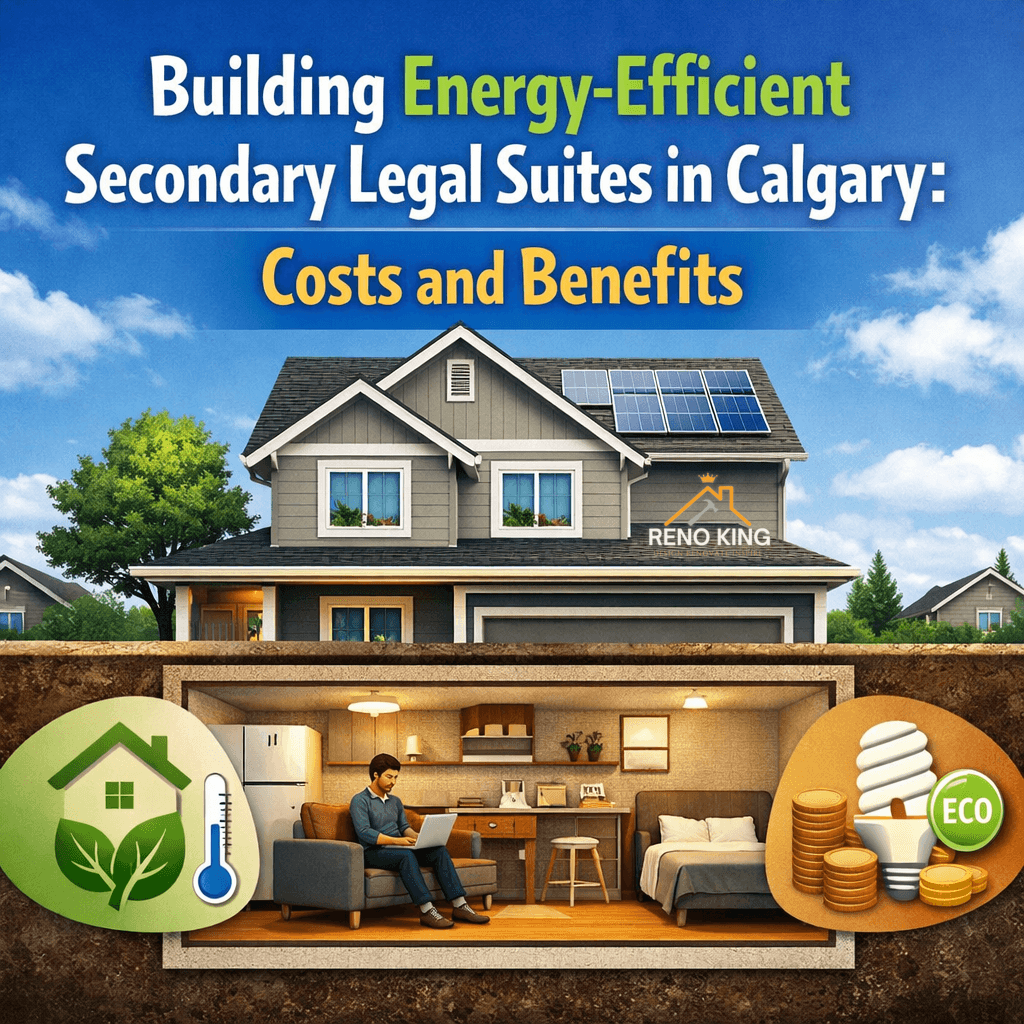
In Calgary, where the housing market remains competitive and families are looking for ways to stretch their budgets, adding a secondary legal suite to your property can be a game-changer. As we move through 2026, the emphasis on energy efficiency is stronger than ever, driven by rising utility costs, environmental concerns, and local incentives. A secondary suite—typically a self-contained unit like a basement apartment, garage suite, or laneway house—can generate rental income, house extended family, or boost your home’s value. When designed with energy efficiency in mind, these suites go even further, offering lower operating costs, better comfort in our cold Alberta winters, and a smaller carbon footprint.
This comprehensive guide breaks down everything you need to know about building an energy-efficient secondary legal suite in Calgary. We’ll cover the legal basics, why efficiency matters in our climate, key design features, a realistic cost breakdown for 2026, financial benefits like ROI and rental income, available incentives and rebates, common challenges with solutions, and inspiring before-and-after examples. If you’re searching for terms like “energy efficient secondary suite Calgary,” “legal basement suite cost 2026,” or “secondary suite rebates Alberta,” this article provides practical, step-by-step information to help you decide if this project fits your needs. With Calgary’s ongoing housing shortage and push for sustainable development, now is an ideal time to explore this option.
Secondary suites have become increasingly popular since the City of Calgary simplified regulations in 2018, allowing more homeowners to create legal units without major rezoning hurdles. By 2026, with updates to the National Energy Code for Buildings (NECB) emphasizing higher efficiency standards, these suites aren’t just about extra space—they’re about smart, future-proof investments. An efficient suite can add $1,500-2,500 in monthly rental income while qualifying for rebates that offset construction costs. Let’s start by understanding the legal framework to ensure your project is compliant from the get-go.
Understanding Legal Secondary Suites in Calgary: Rules and Requirements
Building a secondary suite in Calgary requires navigating specific rules to make it legal, safe, and rentable. A legal suite is a separate dwelling unit on your property with its own kitchen, bathroom, sleeping area, and entrance. The City classifies them into types: basement suites (inside the main home), garage suites (above or beside a garage), laneway houses (detached in the backyard), and carriage houses (similar to garage suites but often standalone).
To comply, your suite must meet the Alberta Building Code and Calgary’s Land Use Bylaw. Key requirements include a minimum ceiling height of 1.95 meters (about 6 feet 5 inches) in habitable rooms to ensure livability, and at least one egress window per bedroom (minimum opening of 0.35 square meters or about 3.8 square feet) for emergency exits. Fire safety is non-negotiable—install smoke alarms, carbon monoxide detectors, and fire-rated separation (like 5/8-inch drywall and self-closing doors) between the suite and main home to prevent fire spread.
Parking is a big consideration: You need one dedicated spot for the suite, which might require driveway expansion if your property lacks space. Utilities must be separate or metered, and the suite can’t exceed 75 square meters (about 800 square feet) or 40% of the main home’s floor area, whichever is smaller, to maintain neighborhood character. For backyard units like laneway houses, setbacks from property lines (minimum 1.2 meters) and height limits (up to 6 meters) apply to avoid overshadowing neighbors.
In 2026, permitting has been streamlined, but you still need a development permit for land use changes and a building permit for construction. The process starts with submitting plans to the City’s online portal, including architectural drawings, site plans, and energy calculations to meet NECB standards (like R-24 wall insulation). Fees range from $500 for simple registrations to $5,000+ for full permits, and approval can take 4-12 weeks. If converting an existing illegal suite, the City’s amnesty program lets you legalize without back fees if you meet codes—check calgary.ca for the registry.
Common pitfalls: Ignoring zoning—most residential areas (R-C1, R-C2) allow suites, but historic districts may not. Non-legal suites risk fines up to $10,000, eviction orders, or insurance denials. Always verify with the City or a planner early. For energy efficiency, 2026 codes mandate better airtightness and ventilation, so plan for features like heat recovery ventilators (HRVs) from the start.
The full process: Assess your property (e.g., basement depth for ceilings), hire a designer for compliant plans ($3,000-8,000), apply for permits, build, and pass inspections. Legal suites not only avoid penalties but also qualify for financing and rebates, making them a secure investment.
Why Focus on Energy Efficiency? Calgary’s Climate & Cost Drivers
Calgary’s climate is a major reason to prioritize energy efficiency in secondary suites. With average winter temperatures around -10°C and extremes dropping to -30°C or lower, heating demands are high. Freeze-thaw cycles cause expansion and contraction in materials, leading to cracks and heat loss if not addressed. Add in dry air from constant furnace use, and inefficient suites become uncomfortable and expensive.
Energy-efficient designs use advanced insulation, sealing, and systems to minimize heat loss, keeping interiors warm without overworking utilities. This is crucial for secondary suites, often in basements prone to cold floors and dampness from snow melt. An efficient suite can reduce heating costs by 40-60% compared to standard builds, saving $800-1,500 annually on utilities.
Cost drivers amplify this: Alberta’s natural gas prices are expected to rise 5-8% in 2026 due to market volatility and carbon pricing. For owners, lower bills mean higher net rental income; for tenants, affordable utilities make your suite more desirable in a market where average one-bedroom rents are $1,600-2,000. Efficient suites also attract eco-conscious renters, allowing premiums of $100-200/month.
Calgary’s dry climate (humidity often below 30% in winter) causes issues like static and respiratory discomfort in inefficient spaces. Efficient ventilation systems maintain balanced humidity without energy waste. Broader drivers include the City’s Climate Action Strategy, aiming for net-zero emissions by 2050, which favors efficient builds through faster approvals and rebates.
Benefits extend to resilience: Efficient suites better withstand power outages with features like insulated walls retaining heat longer. In 2026, with NECB updates requiring higher efficiency ratings (e.g., EnerGuide 80+), non-efficient suites may face resale challenges. Focusing on efficiency turns your suite into a low-maintenance, high-return asset.
Environmental perks: Reduced energy use cuts greenhouse gases—important in oil-dependent Alberta. For homeowners, it’s a way to future-proof against rising costs and regulations.
Key Energy-Efficient Design & Construction Features
Designing an energy-efficient suite starts with the envelope—the walls, roof, and foundation that keep heat in. Use high R-value insulation: Spray foam (R-6-7 per inch) for walls and ceilings seals air leaks, while rigid foam boards under floors prevent cold transfer from concrete. Aim for R-24 walls, R-40 ceilings, and R-10 floors to exceed codes.
Windows and doors are heat-loss hotspots—opt for triple-pane with low-E coatings and argon gas fill, which block UV and retain warmth. ENERGY STAR-rated models reduce condensation, common in Calgary’s humid thaws, and can cut heat loss by 50%. For doors, choose insulated steel or fiberglass with weatherstripping.
Heating and cooling: Mini-split heat pumps are efficient, providing zoned heating without ducts and working well in cold (down to -25°C). Pair with HRVs or ERVs, which recover 70-85% of heat from exhaust air while bringing in fresh air—essential for airtight suites to avoid stuffiness.
Lighting and appliances: LEDs use 80% less energy than incandescents; choose ENERGY STAR fridges, dishwashers, and washers that save on electricity and water. Smart thermostats and sensors optimize usage, turning off lights or adjusting heat automatically.
Water efficiency: Tankless water heaters heat on demand, low-flow faucets (1.5 gpm) and toilets (1.28 gpf) conserve resources—saving 20-30% on bills in water-conscious Calgary.
Other features: Solar panels or pre-wiring for future install, greywater systems recycling sink water for toilets, and smart meters for monitoring.
These elements create a comfortable, low-cost suite. In Calgary, test for radon (common in basements) and include mitigation vents for health.
Pros and cons table for key features:
| Feature | Pros | Cons | Cost Range (2026) |
|---|---|---|---|
| Spray Foam Insulation | Excellent seal, high R-value, mold-resistant | Higher upfront cost, off-gassing if not cured | $10,000-20,000 |
| Mini-Split Heat Pumps | Efficient, quiet, dual heat/cool | Outdoor unit space needed, electricity-dependent | $12,000-25,000 |
| HRV Systems | Fresh air, energy recovery, humidity control | Initial noise, filter maintenance | $3,000-6,000 |
| Triple-Pane Windows | Superior insulation, noise reduction, UV block | Heavier, more expensive | $8,000-15,000 |
Tips: Work with certified installers for rebates; use passive design like south-facing windows for solar gain.
Realistic Cost Breakdown for an Energy-Efficient Secondary Suite in Calgary (2026)
Building costs have risen with inflation, but efficiency adds value. For a 700 sq ft basement suite, expect $180,000-280,000; garage/laneway $200,000-350,000. Breakdown:
- Permits and design: $5,000-15,000 (plans, fees, engineering for efficiency compliance).
- Excavation and foundation: $20,000-50,000 (basement waterproofing or new builds).
- Framing and structure: $25,000-50,000 (sustainable lumber, fire separation).
- Insulation and air sealing: $12,000-25,000 (spray foam, barriers, testing).
- Windows and doors: $10,000-20,000 (triple-pane, insulated entries).
- HVAC and ventilation: $15,000-30,000 (heat pump, HRV, ducts if needed).
- Electrical and plumbing: $12,000-25,000 (efficient wiring, low-flow pipes).
- Finishes (drywall, flooring, paint): $20,000-40,000 (eco-friendly options like cork floors).
- Kitchen and bathroom: $20,000-50,000 (ENERGY STAR appliances, cabinets).
- Miscellaneous (landscaping, parking): $5,000-15,000.
Total average: $220,000 for mid-level efficiency. Factors: Location (suburbs cheaper), size, and upgrades. Save 10-15% by converting existing spaces vs. new construction. In 2026, labor is $50-80/hour, materials up 5%—budget 15% contingency for surprises like soil issues.
Compare to standard suites ($100,000-200,000)—efficiency adds $50,000 but saves long-term.
Financial Benefits: ROI, Rental Income, and Home Value Increase
The payoff is substantial. Rental income: Calgary’s 2026 market sees one-bedroom suites at $1,400-2,200/month; efficient ones command $100-300 more due to low bills. Net annual income: $12,000-20,000 after expenses.
ROI: Payback in 8-15 years via rent and savings ($1,000-2,000/year on energy). At resale, efficient suites add $100,000-250,000 to value—often 80-100% recovery.
Tax benefits: Deduct interest on loans, depreciation (over 27.5 years), and repairs as business expenses if rented.
Other perks: Multi-generational living saves on separate housing; efficiency reduces vacancy by attracting tenants.
Long-term: In a green-focused market, efficient properties sell faster.
Available Incentives, Rebates, and Financing in Calgary 2026
Incentives make projects affordable. CEIP: 3.75% low-interest loans for efficiency upgrades like insulation or heat pumps, up to 25 years, covering 100% costs.
Canada Greener Homes Grant: Up to $5,000 for retrofits, plus $600 for audits—applies to suites if part of home.
City of Calgary Secondary Suite Program: Grants up to $10,000 for legalizing or building.
Utility rebates: ENMAX/ATCO offer $500-1,500 for ENERGY STAR items or HRVs.
Federal programs: Home Accessibility Tax Credit if for seniors.
Stack them: Save 20-40%—e.g., $20,000-50,000 on a $200,000 project. Apply via city portals; 2026 deadlines: CEIP ongoing but funds limited.
Common Challenges & How to Overcome Them
Challenges abound, but solutions exist. High costs: Offset with rebates, finance via CEIP.
Climate issues: Use proper waterproofing (sump pumps, drains) and insulation to prevent dampness.
Permitting delays: Submit early, use pre-approved plans.
Construction disruptions: Phase work, communicate with neighbors.
Tenant finding: Market efficiency features on Kijiji or Rentfaster.
Overcome with planning—hire experienced teams for compliance.
Before-and-After Inspiration: Real Calgary Secondary Suite Examples
Inspiration shows results. Before: Dim basement with drafts; after: Bright suite with HRV, heat pump—tenant loves low bills.
Another: Garage to laneway with solar—rents for $2,100/month, owner saves on taxes.
These Calgary examples highlight transformation and benefits.
Conclusion: Is an Energy-Efficient Secondary Suite Right for You?
Energy-efficient secondary suites offer income, value, and sustainability in Calgary. Weigh costs against benefits—if your property suits and budget allows, it’s worthwhile.
For smooth building, local experts like Reno King, with 23+ years, 846 projects, and eco-commitments like 10 trees per job, can guide you. Contact them for tailored advice.