
Friday, December 12, 2025
In the modern corporate world, the greatest currency isn’t just time—it’s attention. As we move into the colder months, businesses often find themselves at a crossroads. The frantic pace of the year-end wrap-up meets the physiological “slow down” that winter naturally brings. However, for the forward-thinking business owner or facility manager, winter isn’t just a season of hibernation; it is the ultimate window of opportunity.
The concept of “Deep Work,” popularized by professor Cal Newport, refers to the ability to focus without distraction on a cognitively demanding task. It’s the kind of work that creates new value, improves skills, and is hard to replicate. Yet, most office interiors are designed for “shallow work”—emails, meetings, and constant interruptions.
By utilizing the winter season to renovate and optimize your physical space, you can cultivate an environment where Deep Work isn’t just possible—it’s inevitable.
1. The Psychology of the Office: Why Space Matters
Before we look at floor plans or paint swatches, we must understand the “why.” Human beings are profoundly affected by their environment. The “Open Office” trend of the early 2010s was intended to foster collaboration, but study after study has shown it actually decreased productivity and increased stress due to “noise pollution” and a lack of privacy.
When you renovate with a focus on Deep Work, you are essentially “nudging” the brain into a state of flow. By changing the physical architecture of your office, you change the mental architecture of your team. This is known as “Enclothed Cognition” or environmental psychology—the idea that our physical surroundings influence our cognitive processes. If the office feels chaotic, the work produced will likely feel the same.
2. The High Cost of “Context Switching”
One of the primary reasons modern offices fail is the frequency of interruptions. Research suggests that it takes an average of 23 minutes and 15 seconds to return to the original task after an interruption. In a standard open-plan office, an employee might be interrupted every 11 minutes. Mathematically, this means many workers never reach a state of Deep Work.
Winter renovations allow you to address this by creating “Focus Pods” or “Heads-down Zones.” These aren’t just cubicles; they are specialized environments designed to signal to the brain—and to colleagues—that the person inside is in a state of high-concentration. By physically separating these areas from the high-traffic zones (like the breakroom or entrance), you drastically reduce the “Context Switching” tax on your team’s brainpower.
3. Zoning for Cognitive Focus: The Library Effect
The most successful winter renovations start with a re-evaluation of the floor plan. We often think of offices as either “open” or “private,” but the most productive spaces use a tiered approach, much like a university library.
The Deep Work Zone (The “Silent Library”)
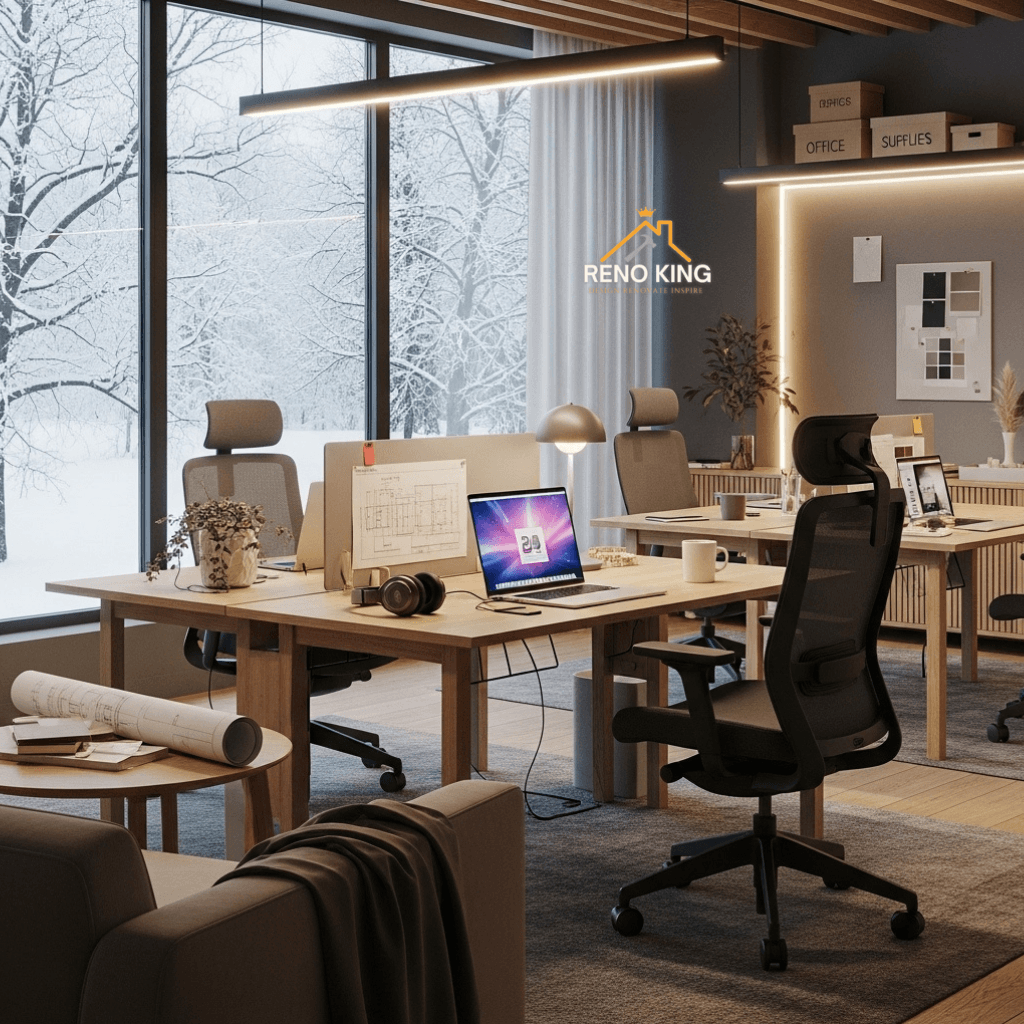
Imagine a space where the rules are clear: no talking, no phones, and no interruptions. During a winter renovation, you can create these “Deep Work Cells.” These are high-comfort, high-focus areas equipped with:
- Built-in acoustic shielding: Using wrap-around seating or acoustic felt walls.
- Visual Privacy: Using frosted glass or “living walls” (plants) to block peripheral distractions.
- Ergonomic Excellence: Investing in chairs that support focus for 90-minute intervals.
The Collaborative Hub (The “Social Cafe”)
Collaboration is still vital, but it shouldn’t happen at someone else’s desk. By renovating your common areas to look and feel more like a high-end cafe, you encourage social interaction in a specific place. Using materials like reclaimed wood, warm lighting, and soft seating encourages a different type of brain activity—divergent thinking—which is essential for brainstorming and culture building.
4. Acoustic Engineering: Silencing the Distraction
Sound is the number one enemy of Deep Work. It’s not just the volume; it’s the intelligibility of speech. If you can hear what your colleague is saying on the phone, your brain is hard-wired to try and process that information, even if you’re trying to ignore it.
Winter is an excellent time to address acoustics because it often involves ceiling modifications or the installation of heavy wall treatments that are easier to manage when staff might be working remotely during the holidays.
- Acoustic Ceiling Clouds: These hanging panels absorb sound waves that usually bounce off hard ceilings, preventing the “echo chamber” effect.
- Sound-Masking Systems: Modern “pink noise” systems can be integrated into the HVAC or ceiling to create a consistent audio floor. This makes distant conversations unintelligible and less distracting.
- Soft Flooring: Swapping hard surfaces for high-quality acoustic carpeting or luxury vinyl tile (LVT) with sound-dampening underlays can reduce footfall noise by up to 50%.
5. Lighting the Dark Months: The Neurochemistry of Focus
In winter, natural light is at a premium. The “Winter Blues” or Seasonal Affective Disorder (SAD) isn’t just a mood issue—it’s a productivity killer. When employees are starved for light, their bodies produce more melatonin during the day, making them feel sluggish.
Human-Centric Lighting (HCL)
A winter renovation should prioritize smart lighting systems that utilize Human-Centric Lighting. These systems mimic the sun’s natural cycle:
- Morning (Blue-Enriched): High-intensity cool light suppresses melatonin and triggers cortisol, helping the team wake up and focus.
- Afternoon (Balanced White): Maintains energy levels without causing eye strain.
- Late Afternoon (Warm Amber): Gradually shifts to warmer tones, helping the body prepare for the evening and ensuring that work doesn’t disrupt the employees’ sleep-wake cycles.
Maximizing the Window Reach
During your renovation, consider “Daylight Harvesting.” By using glass partitions instead of solid drywall, you allow light to penetrate into the center of the office. This “borrowed light” ensures that even those sitting away from the windows benefit from the sun’s Vitamin D-boosting rays.
6. Thermal Comfort and the “Productivity Chill”
Have you ever tried to type a complex report or code a script when your fingers are cold? It’s nearly impossible. Research from Cornell University shows that when office temperatures are low (around 68°F or 20°C), employees make 44% more mistakes than when the temperature is at an optimal 77°F (25°C).
Winter renovations allow you to fix the “Micro-Climates” in your office:
- Smart Thermostats & Zoning: Don’t heat the whole building to the same degree. Use smart sensors to heat only the rooms currently in use.
- Radiant Heating Panels: For “Deep Work” zones, consider radiant heat panels. Unlike noisy forced-air systems that can be distracting, radiant heat is silent and provides a “sun-like” warmth that keeps the body comfortable without drying out the air.
- Hygge Breakout Spaces: Integrate “warm” design elements like wool textures, wood finishes, and even electric fireplace features in break rooms to give the brain a “sensory reset.”
7. Biophilic Design: The Winter Escape
Biophilia is the innate human tendency to seek connections with nature. In the dead of winter, when the world outside is gray and leafless, bringing “greenery” inside has a massive impact on mental health and cognitive recovery.
- Vertical Gardens (Living Walls): These act as natural air filters, sound absorbers, and visual anchors.
- Natural Materials: Replacing cold plastic and metal surfaces with wood, stone, or cork.
- Air Quality Upgrades: Since windows stay shut in winter, CO2 levels can spike, making people feel “foggy” by 3:00 PM. Renovating your ventilation system with HEPA filters and UV-C light purification ensures the brain is getting the oxygen it needs to think deeply.
8. Agile Infrastructure: Preparing for the Future
A renovation shouldn’t just solve today’s problems; it should anticipate tomorrow’s. “Agile” office design involves creating spaces that can be easily reconfigured. During your winter renovation, consider installing:
- Underfloor Power Tracks: This allows you to move desks and “Focus Pods” without expensive electrical rewiring later.
- Mobile Acoustic Screens: These can be moved to create temporary “war rooms” for specific projects.
- Integrated Tech Hubs: Ensure every meeting space is “hybrid-ready” with 4K cameras and high-fidelity microphones so that remote team members aren’t a distraction to those in the office.
9. The Strategic Timing of Winter Renovations
Why now? Many businesses wait until summer to renovate, but winter offers unique strategic advantages:
- Lower Disruption: With many employees taking holiday leave or working flexibly during the winter break, the “chaos” of construction impacts fewer people.
- Contractor Focus: Contractors often have more availability in January and February compared to the frantic summer rush, leading to better attention to detail and tighter timelines.
- The “Fresh Start” Effect: Completing a renovation in late winter means your team returns to a “new” office just as the spring market begins to accelerate. This boosts morale exactly when the business world starts to ramp up its pace.
10. Color Psychology for Focus and Flow
The colors you choose during your winter refresh will dictate the mood of the office for years to come. Color is more than just an aesthetic choice; it’s a psychological tool.
- Blues and Greens: These colors are associated with nature and the sky, which the brain perceives as “safe” and “calm.” They are best for focus and are perfect for the “Silent Library” zones.
- Soft Yellows and Oranges: These stimulate creativity and energy. Use them sparingly in collaborative zones to spark conversation.
- Deep Teals and Grays: These provide a sense of sophistication and “weight,” perfect for executive boardrooms where high-stakes decisions are made.
11. Conclusion: Investing in Your Best Asset
Your office is more than just a place where people sit; it is a tool for performance. In the age of AI and automation, the human ability to engage in “Deep Work” is your company’s greatest competitive advantage. By focusing on “Interior Deep Work,” you are telling your team that you value their focus, their mental health, and their output.
A winter renovation isn’t just about changing the walls; it’s about changing the culture of productivity. It’s about creating a sanctuary where the best ideas can flourish, undisturbed by the noise of the outside world.
Why Choose Reno King?
Transforming an office into a Deep Work sanctuary requires more than just a general contractor; it requires a partner who understands the intersection of construction, neurological design, and corporate efficiency.
At Reno King, we specialize in high-impact winter renovations that respect your timeline and your bottom line. We understand that every day your office is under construction is a day of potential lost productivity, which is why we pride ourselves on “Military Precision” project management.
We don’t just “fix” spaces; we re-imagine them. Whether you need to overhaul your acoustics to silence the office chatter, implement human-centric lighting to beat the winter blues, or create dedicated focus zones that help your team reach peak performance, our expert team is ready. We handle everything from the initial “Productivity Audit” to the final finishing touches.
This winter, don’t let your productivity freeze. Let Reno King help you build the environment your team deserves.
Ready to maximize your office potential?
📞Contact Reno King today for a winter consultation and let’s start planning your most productive year yet.