
Monday, November 10, 2025
An office renovation in Calgary represents far more than just a physical change; it is a profound investment in a company’s future, a testament to growth, and a critical tool for talent retention and brand identity. However, the path to a revitalized workspace is fraught with the potential for costly delays, productivity loss, and operational chaos. For any business—from professional services in the downtown towers to industrial operations in the Southeast—maintaining continuity is the highest financial priority. The money saved by avoiding a complete shutdown and preserving client-facing integrity far outweighs the premium paid for strategic, low-disruption construction.
This definitive, in-depth guide provides a tactical framework for business owners and facility managers in Calgary, detailing the six critical pillars of planning required to execute a complex commercial renovation with surgical precision and minimal impact on daily operations.
Pillar 1: The Strategic Foundation – Phasing, Zoning, and Decanting
The moment a renovation is approved, the most critical decision is the methodology of execution. In an operational environment, you must reject the “Big Bang” approach (shutting everything down) in favour of a carefully managed phased transition.
The Phased Renovation Methodology: The “Musical Chairs” Approach
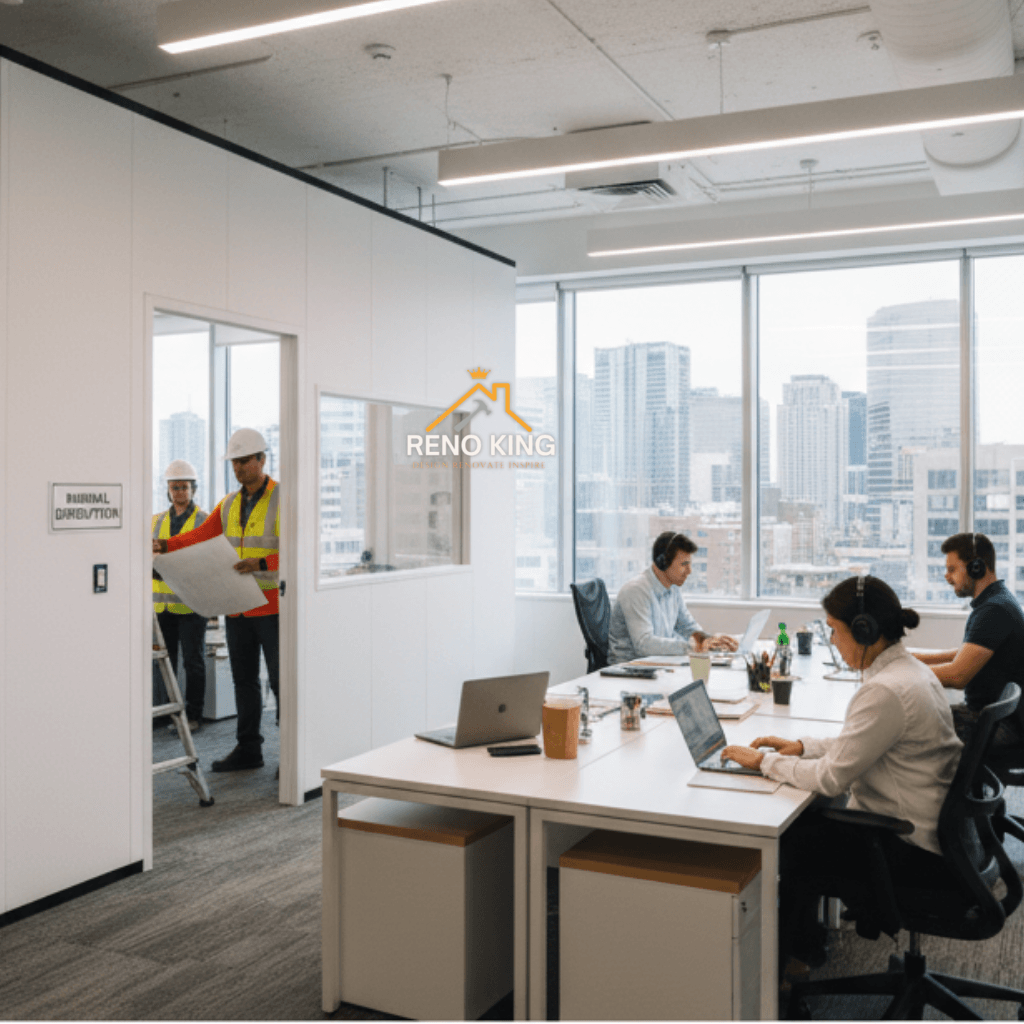
A successful phased renovation is structured like a game of musical chairs, but the music never stops. Work is broken down into small, distinct, and time-bound zones, ensuring that construction is always isolated to an empty area.
- Zone Definition and Sequencing: Work with your contractor and interior designer to create a Renovation Zone Map. Zones should be based not just on location (e.g., North Wing vs. South Wing) but on departmental function. For example, the finance department (which has high security and time sensitivity) should never be in the same phase as the marketing department (which might tolerate more noise). Critical zones must be completed early to serve as reliable relocation spots.
- The Swing Space Mandate: The Swing Space is a pre-renovated or temporary area designed to house staff from the active construction zone. This area must meet all current code requirements for safety, power density, and connectivity. Crucially, the first phase of the project is often the creation of this swing space, ensuring it is ready weeks before the first demolition begins.
- Micro-Phasing in Detail: For highly specialized environments (like medical clinics or legal firms), even large departments may need to be broken down. This is micro-phasing. Instead of renovating the entire accounting department at once, you might renovate 10 desks in the area, move 10 staff to the swing space, and then repeat the process three more times. This allows for hyper-localized containment and minimizes mass moves.
Decanting: The Temporary Relocation Strategy
In some cases—especially major restructurings, multi-floor demolitions, or significant HVAC overhauls—a short-term, total move is unavoidable. This is known as Decanting.
- Pre-Planning the Decant: If you anticipate two to four weeks of major structural chaos (e.g., jackhammering new elevator shafts or pouring new concrete floors), pre-lease a furnished, temporary office (often called an executive suite) in a nearby commercial hub.
- Decanting vs. Shutdown: Decanting is a planned and temporary move to a fully functional space, unlike an unstructured shutdown where business is simply paused. The focus is on strategic relocation, ensuring mission-critical equipment moves first and is running at the new location before the main team arrives. This minimizes the productivity loss from weeks to days.
Pillar 2: The Clockwork – Mastering Off-Hours and Time-Sensitive Logistics
In Calgary’s commercial landscape, the cost of labor during off-hours is a necessary operational expense, not a discretionary luxury. The scheduling of work is the single greatest determinant of operational disruption.
The Night Shift, Weekend, and Holiday Mandate
All tasks that generate significant noise, dust, vibration, or utility interruption must be performed when the office is either empty or at its minimal staffing level.
| Activity Type (High Impact) | Specific Examples | Optimal Timing & Rationale |
| Structural Demolition | Core drilling, slab breaking, load-bearing wall removal, pneumatic hammering. | Saturdays/Sundays (Full Day) or 8:00 PM – 4:00 AM (Weeknights). This prevents productivity loss from deafening noise and minimizes vibration risk to sensitive equipment. |
| Utility Interruption | Main electrical panel cutovers, fire suppression system tie-ins, server room power upgrades. | Friday Night (6:00 PM onwards) or Statutory Holidays. This provides the entire weekend or a long weekend to test, troubleshoot, and correct any failures before the next business day. |
| Heavy Mechanical | Hoisting large HVAC units, welding structural steel beams. | Early Morning (4:00 AM – 8:00 AM). Use freight elevators before peak business traffic, ensuring that the work is contained before staff arrivals. |
Rigorous Staging and Just-In-Time (JIT) Delivery
A disorganized construction site breeds safety hazards and compounds disruption. Materials—especially bulky items like drywall, steel studs, and insulation—must be efficiently staged.
- JIT Strategy: Work with your contractor to implement a JIT materials delivery system. This means materials arrive just as the crew is ready to install them, rather than weeks in advance. This prevents materials from cluttering common areas, blocking emergency exits, or taking up valuable swing space.
- Loading Dock Coordination: In high-rise Calgary buildings, loading dock and freight elevator usage is often managed by a central building operator. Your contractor must pre-book specific time slots—often weeks in advance—for all major deliveries. Failure to do so can result in material sitting on the street for hours, incurring demurrage costs and blocking traffic.
Pillar 3: Environmental Control – Containment, Air Quality, and Vibration
Minimizing sensory assault—dust, fumes, and sound—is critical to maintaining high employee morale and protecting expensive IT assets.
Advanced Dust Mitigation: The Two-Stage Defense
Simple plastic sheeting is insufficient for commercial environments. Effective dust control requires advanced mechanical intervention.
- Hoarding and Sealing: Use temporary drywall hoarding instead of plastic, particularly for multi-week projects. Drywall provides a superior seal and significantly better sound attenuation. All seams must be sealed with duct tape and caulk, extending the seal deep into the ceiling plenum and under door gaps.
- The Negative Air Pressure System: As detailed previously, Negative Air Machines (NAMs) create a vacuum in the work zone. However, for large projects, you may need multiple units, strategically placed to create a directional flow of air away from critical departments. The filtered air must be exhausted outside or into a non-occupied, properly ventilated area of the building, adhering to local Calgary air quality and building codes.
- Containment Vestibules (Airlocks): Where access is required into the construction zone (e.g., via a secured hallway), establish a small, separate, double-door vestibule between the clean office and the dusty work zone. This acts as an airlock, capturing residual dust before it can escape into the main office.
Vibration Monitoring and Sensitive Equipment Protection
Heavy demolition and drilling can generate vibrations that travel through the structural steel and concrete of commercial buildings.
- Risk Mitigation: If your office contains sensitive equipment (e.g., server racks, specialized lab equipment, or high-precision machinery), a vibration monitoring report may be necessary. Contractors can use specialized equipment to monitor vibration levels near critical assets, ensuring they remain below safe thresholds.
- Server Room Defense: Beyond dust control, critical IT equipment must be protected from heat and power fluctuations. Ensure the contractor runs temporary power cords around the server room to avoid tripping main breakers, and confirm the server room’s dedicated CRAC (Computer Room Air Conditioner) unit remains fully functional and isolated from the construction zone’s exhaust.
Pillar 4: Technology and Infrastructure Continuity
The modern office is a network, not just a physical structure. Unplanned disconnection of IT assets is the single most expensive form of disruption.
Detailed Asset and Utility Mapping
The success of the IT relocation hinges on precise documentation made before the first wall is opened.
- Audit and Documentation: The IT team, electrician, and contractor must conduct a joint discovery walkthrough. They must confirm the exact location of all main riser closets, fiber optic termination points, and uninterruptible power supply (UPS) units. Every wire and conduit running through the wall must be digitally mapped.
- Modular Wiring Systems: For maximum flexibility in phased moves, the contractor should integrate modular wiring systems (pre-terminated cables and plugs) into the new construction. This allows workstations to be disconnected and reconnected in the swing space and then again in the final space with simple plug-and-play connections, eliminating costly, time-consuming field termination by a data technician for every single move.
- Dedicated Power Circuits: Clearly identify which circuits power essential equipment (servers, fire suppression, security cameras) and ensure the contractor does not use or disrupt these critical circuits for their tools. Temporary power for the construction zone must be pulled from a separate, dedicated source.
The IT Cutover Protocol
The moment power or data is transferred from an old system to a new one is the highest-risk time of the project.
- The Protocol: Create a formal, written protocol that dictates all cutovers occur on a weekend. The protocol must include a mandatory 24-Hour Soak Test. Once the new network is connected, the system must run for 24 hours under a simulated load to check for heat issues, signal degradation, or power faults before any employee logs in.
- Remote Work Readiness: During a critical move, the entire staff should be mandated to work remotely. This stress-tests the VPN and remote access infrastructure, providing a necessary, temporary buffer while the team manages the physical change in the office.
Pillar 5: Communication, Safety, and Morale
Maintaining employee trust and managing stakeholder expectations are soft skills that directly affect hard metrics like productivity and retention.
The Communication Hierarchy and The Liaison Role
Effective communication requires a clear hierarchy and a single point of authority.
- Executive Level: The CEO or Senior VP provides broad, infrequent updates on project goals, ROI, and major milestones to the entire company and key external stakeholders (investors, large clients). This focuses on the vision.
- The Renovation Liaison (The Daily Manager): This individual, empowered by the executive, is the sole point of contact with the General Contractor. They manage the logistics of the move, approve daily noise schedules, address staff complaints immediately, and manage the technical cutovers.
- Staff Level: Communication must be hyper-local. Departments affected by a specific phase should receive granular details about access changes, elevator status, and specific noise schedules, preventing the frustration of the unknown.
Safety Protocols in an Occupied Environment
In an occupied Calgary office, safety is not just about the construction crew wearing hard hats; it’s about protecting the staff from the construction.
- Wayfinding Signage: All detours, construction zones, and emergency exits must be clearly marked with professional, highly visible signage (avoid handwritten notes). These signs should be reviewed daily by the safety manager and the contractor.
- Third-Party Audits: For large-scale projects, consider engaging a third-party safety consultant to perform periodic, unannounced inspections. This objective oversight ensures the contractor maintains the highest safety standards for barriers, power tools, and material storage within a live commercial environment.
- Contingency for Unexpected Findings: Older Calgary buildings may reveal hazards behind the walls (e.g., lead paint, undocumented asbestos). The plan must include a clear, budgeted protocol for immediate, safe abatement by licensed specialists, as mandated by local health and safety regulations.
Pillar 6: Budgeting for Contingency and Measuring Operational ROI
The goal of minimal disruption planning is to eliminate unbudgeted operational costs—the true cost of chaos.
The Contingency Fund for Disruption
A renovation contingency fund is not just for material overruns; a major portion should be allocated to managing disruption.
- Budget Allocation: The industry standard for commercial renovation contingency is 10% to 15% of the total construction cost. For a high-risk, occupied renovation, a minimum of 15% is strongly recommended.
- Disruption-Specific Reserves: Allocate reserves for things like: the unexpected rental of a mobile air conditioner if the main HVAC is down for longer than anticipated, providing temporary commuter support (taxi or parking vouchers) for staff displaced to a less accessible swing space, or paying for emergency after-hours IT support during a cutover failure.
Measuring Success: Operational Return on Investment (ROI)
The final measure of a minimally disruptive renovation is the Operational ROI—the success of the project in meeting its functional and human-centric goals.
- Pre- and Post-Productivity Audits: Measure a key metric (e.g., call volume handled, projects completed per employee, sales closed) during a control period before the renovation and compare it to the same metric during the renovation phase. A good contractor minimizes the gap between these two metrics.
- Staff Satisfaction Surveys: Conduct anonymous surveys three months post-completion. Questions should focus not just on aesthetics, but on function: “Has the new lighting improved your focus?” “Do the new collaboration spaces make meetings more effective?” This feedback validates the investment in the renovation’s purpose.
- Utility Cost Reduction: Track energy consumption after the renovation. Investing in high-efficiency HVAC and LED lighting—key components of a modern Calgary office—should result in measurable, long-term savings that prove the financial value of the upgrade.
Finalizing Your Vision: Partnering for Seamless Execution
The complexity of a low-disruption commercial renovation demands a partnership, not just a contractor-client relationship. The firm you choose must possess specialized expertise in managing occupied environments and be intimately familiar with the specific permit processes, building codes, and logistical challenges unique to Calgary’s commercial properties. They must demonstrate a commitment to your clock, not just their own.
At Reno King, we have engineered our entire process around the principle of Business Continuity. Our team of project managers specializes in creating the precise phasing schedules, rigorous containment protocols, and seamless IT cutover plans detailed in this guide. We provide transparent, itemized bids that explicitly budget for the essential elements of minimal disruption—from after-hours labor premiums to the deployment of negative air technology. We ensure your Calgary office not only meets its design aspirations but achieves them without sacrificing productivity, safety, or client trust.
Ready to transform your workspace while keeping your business fully operational?
📞Contact Reno King today for a strategic consultation and let us design a zero-downtime roadmap for your next commercial renovation.